Showing posts with label resume. Show all posts

Boost Your Career with These 3 Resume Tips

Essential Strategies to Stand Out in the Job Market

This popular resume advice is ‘a waste of time’, says former head of talent acquisition at Nike

Gili Malinsky

When you’re applying for a job, many career experts will tell you to tailor your resume to the job description. They recommend sifting through its requirements to see what’s most relevant for the role and tweaking your resume accordingly.

Longtime HR executive James Hudson, who’s led talent acquisition at companies like Nike and Levi Strauss & Co., disagrees with this approach. “It’s bad advice to customize your resume” for every role, he says. In fact, as far as a jobseeker is concerned, it’s “a waste of time.”

Here’s why he thinks so.

Descriptions are often ‘managed by the compensation team’

There can be a slight disconnect between what a job description asks for and what a hiring manager might be looking for in any given role. That gap stems from how an organization creates its job descriptions.

Internally and especially in large companies, “job descriptions are typically owned and managed by the compensation team because they’re directly linked to pay bands within the organization,” says Hudson. A pay band is an internal salary range for each role. That means the person writing the job description will not necessarily be the person doing the hiring, and therefore may not know exactly what a hiring manager or recruiter is looking for on the ground.

“The basic qualifications are always going to be exactly right,” says Hudson, such as degree and experience requirements, “but there’s so much more in a job description than the basic qualifications.”

You’ll have a chance to better suss those out during the interview process and if you speak to someone at the company before you apply. But the job description itself might not give a 100% sense of where the emphasis will be on day-to-day job duties.

Read the 2nd reason and the complete CNBC article


Does Your Résumé Pass 6-Second Test? - 4 Tips

By Kailyn Rhone

No pressure, but your résumé has six seconds to make an impression before it is sent to the don’t-even-bother pile.

That is how long a recruiter typically skims a résumé to decide whether to pass it on to a hiring manager, said J.T. O’Donnell, chief executive of career-coaching site Work It Daily. Recruiters often have hundreds of online applications to wade through, even with algorithms helping filter many of them out. They will likely give yours little more than a glance to judge whether you make it onto the shortlist of candidates.

In other words, your résumé has to be highly “skimmable,” Ms. O’Donnell said at The Wall Street Journal’s recent Jobs Summit. “The human eye works in a Z-pattern, and I’m going down, looking for four to five things that I was told you need to have or you cannot be considered.” 

The CV won’t clinch a job offer, but it gets you to the next step, she and other career coaches say. A résumé that’s hard to skim or fails to mention key skills needed for the job could keep you from ever getting the chance to make your case in an interview. 

Some ways to make your résumé stand out, and some job-search killers to avoid, according to the experts at the summit:  

1) Forget the professional statement.

Job seekers have long been advised to include a short paragraph atop of their résumé summing up their skills, experience, achievements and goals. No more.

“Recruiters don’t have time for that,” Ms. O’Donnell said. Instead, open with a one-line “headline” stating your occupational specialty—ideally with words matching the role you’re applying for, like “digital marketing specialist” or “technical writer,” she said. 

Follow the headline with two short columns of bullets with concrete skills. If you coordinated a team to pull off a big assignment and the job posting mentions project-management experience, use that same language, since that’s what recruiters and their applicant-tracking-systems will screen for, said Jane Oates, president of WorkingNation, a nonprofit focused on workforce development. 

“Every job you apply for, you should customize your résumé just a little bit by putting in some of the words that are in that job description,” Ms. Oates said.

3) Use numbers.

Avoid subjective, ambiguous language, such as “passionate self-starter” or a “dedicated hard worker.” The hiring manager or recruiter will assess your soft skills when they interview you, Ms. O’Donnell said. A résumé is about your hard skills, which are best told through numbers.  

Her tip: Circle all of the nouns on your CV, because they can usually be quantified.

If you are describing your experience as a receptionist, for instance, don’t just say “Answer phones.” More effective is something like: “Work for a 300-person company, answering more than 100 calls a day, on a 12-line phone system,” she said.

See all 4 tips + video and complete WSJ article


10 Résumé Hacks That Are Proven To Work And 7 That'll Probably Just Send Your Application To The "No" Pile

It's about to be a new year, which means it's the best time of year to be dusting off those résumés and getting ready to take a leap in 2023 with your career. According to Business News Daily, January and February are the best months to look for a job. So, let's avoid getting dumped into the "Thank u, Next" pile and get hired right away!

Peacock

Résumés seem so simple, but some hacks will actually help you advance to round two in the job application process. If you're tired of applying and feel like you are hitting a dead end, check out some of these hacks that will guarantee you receive a callback.


3.Achievements

ABC Network / Via giphy.com

A lot of articles recommend tailoring your language when describing your work experience. Resume Worded says your résumé should be "achievement-based," not responsibility-oriented. Instead of stating your job duties, mention what made you stand out in that role.


4.Meaningful File Name

Deedle Dee Productions / Via giphy.com

Stop turning in résumés labeled "Résumé." It's that simple. At least add your last name or the job position you are applying to.

Indeed's employment site recommends candidates keep the file name under 24 characters. A perfect example of a file name for a résumé would be Brenda-Murphy-Resume.docx or AustinStaadt-Resume.pdf. 


7.PROOFREAD

Peacock / Via giphy.com

No matter what, before you hit that submit button, make sure to proofread and proofread. Reading out loud will really force you to hear how you sound and can save a job application in a heartbeat.

CNBC Make It reports grammatical and spelling errors are one of the top five mistakes candidates make on their applications.

And here are some things that will definitely not move you on to the next round of the job process.


12.Photo

BabyWay Productions / Via giphy.com

Photos are a complete "NO" because a photo isn't needed if it's not a modeling or acting career. If you feel a photo is important, then a great workaround would be to include your LinkedIn page in a hyperlink.

LinkedIn says, "Résumé standards have changed, but photos on résumés are still rare." Unless it's necessary, photos shouldn't be on résumés.


13.Personal Information

Bravo / Via giphy.com

Maybe adding your address was useful back in the day, but employers don't need to know where you live. A city and state will suffice. Also, never include your age; recruiters shouldn't ask your age. Though there isn't a law advising against it, it could be viewed as evidence of bias.

They'll do the math from your birth year if they really want to know.


Read the full BuzzFeed Via Yahoo article for all the Hacks!


7 updates your résumé needs now

Without a refresh, your résumé can quickly look dated. Here are seven ways to give it a quick update.

BY GWEN MORAN 

Résumé-writing typically comes with a list of best practices. Tailor your résumé to the job. Focus on the impact you made instead of the tasks you performed. And, most of all, be sure it’s accurate and free of typos. A recent analysis by job search platform Adzuna found that meaning almost roughly two-thirds of résumés contained at least one mistake. More than 13% of the résumés analyzed contained five or more errors.

But, beyond that, there are a few more nuanced details that can make your résumé look modern—or dated, says career coach and résumé consultant Marjorie Sherlock. “The résumé has evolved as a marketing tool, driven by what the market is telling us,” she says. And much of what was expected even 10 years ago is “completely dead.”

The risk of submitting a résumé that looks a little behind the times is what it says about you: Perhaps you’re not up on trends or how industries evolve, Sherlock explains. So, if it’s been a few years since you’ve updated your professional calling card, give it a look with these tips in mind.

4) GET THE FORMAT RIGHT

While applicant tracking systems have come a long way, it’s still a good idea to avoid heavy graphics or tables to present information in your résumé, Sherlock says. And use one space after a period rather than two. (Word processing programs automatically adjust spacing—typewriters didn’t—so, there’s no need for the extra space.)

** I have looked at a lot of resume that would have looked nice if they were printed out but the parsing function doesn't like all of the columns and graphics so it cuts down on your odds of being found through keyword searches.

5) BE SUCCINCT

Résumé consultant Donna Svei limits clients’ résumés to 700 to 800 words. “Very few recruiters and hiring managers want to read more than that,” she says.

Similarly, she advises avoiding large blocks of text, which are hard to read, especially on mobile devices. People start losing interest after about four lines, she says. “Technology shifted résumés from paper to screens, and job seekers who haven’t adapted to the change with shorter paragraphs that are easier to read on screens look dated,” she says.

AVOID TRIPS DOWN MEMORY LANE

Periodically, it’s a good idea to cull the information you include on your résumé to keep it more focused on today. Since 2007, the pandemic and Great Recession have changed so much about work and the way things get done. Unless the experience is “stunningly relevant” to your goals, consider dropping it in favor of more recent and relevant experience. Awards, speeches, and publications older than about four years may be past their expiration date, she adds.

Read the full Fast Company for all 7 updates article

5 Ways To Improve Your CV | Resume

Andrew Fennell

If your job search isn’t going as planned, and you’re seeing more rejections than you had hoped for, your CV is probably the main culprit.

A CV that doesn’t reflect your strengths adequately to recruiters and employers is never going to help you reach your lofty careers goals.

So, if you’re currently being held back from your next big career move, here are five fool-proof ways you can give your CV an upgrade and start getting more responses in the job market.

4) Upskill

One way to instantly boost your employability and make your CV look great is to learn some new skills. For example, you might wish to learn how to use new tools or software, remote working practices, or even just upgrade your knowledge in your current field.

There are multiple ways you can do gain skills nowadays; you could take an online course or digital workshop, listen to podcasts or watch tutorials. Alternatively, you could join an evening class or ask someone in your current workplace to teach you.

However you choose to go about it, it’s a good idea to work out your objectives first as this will help you choose the right type of course or training for your career. Let’s say you have an ideal new job in mind; you can take a look over similar job descriptions to find out what sought-after skills or know-how you’re missing. This will help to guide you in your pursuit of knowledge and new skill sets.

5) Strip out irrelevant details

When you’ve had a long or established career, you might have years of experience and multiple qualifications behind you, but over time these can become less relevant and simply take up precious space.

In fact, when it comes to your CV, the information you choose to leave out can be just as important as the information you choose to include.

The best approach to take is to examine the job description and see what the employer is after, then omit any information that is not relevant or required for the role.

For example, in your employment history, you can leave out any roles that aren’t relevant to the industry or position you’re applying for and cut down any older roles to just one-line summaries.

By stripping out any outdated or irrelevant information, you make it much easier for the recruiter to find the relevant information that proves you’re a good fit for the role.

So, if you are looking for a new position this year, keep this advice in mind when writing your CV. Even just one of our five tips could be enough to instantly boost your CV and help you secure an interview.

See tips 1-3 and the complete Forbes article


Remove these 7 things from your resume ASAP


We constantly hear about what you should put on your resume, but we rarely talk about what to leave off.

As the CEO of a resume writing service, I’ve read more than a thousand resumes this year so far, and I’ve seen a lot of “junk” that doesn’t belong — things that can hurt your chances of landing an interview.

If you want to write a resume that says “Hire me,” then every word, number, line and achievement must be carefully considered. So let’s hit the backspace button on seven commonly overlooked things you should remove from your resume ASAP — and why:

1. Irrelevant hobbies and interests

Love esports? Camping? Coin collecting? Gardening? Everyone has a hobby, and most people think that the more unique it is, the more it will make them stand out from other candidates.

But hiring managers don’t care about how you spend your free time — at least not immediately. They have deadlines and large piles of resumes to review, and right now, they’re just focused on finding candidates who meet the requirements.

Of course, it’s okay to include your hobby if it’s related to the position you’re applying for. If it’s a finance job, for example, mentioning that you like to dabble in cryptocurrency investing can be seen as a plus. But if you’re trying to land a medical research assistant role, don’t bother.

4. Personal pronouns

Surprisingly, many candidates still make the mistake of using personal pronouns — “I,” “me,” “we” — on their resume.

Why leave out personal pronouns? Because it’s your resume, so it’s already implied that everything on it is about you. Instead of writing, “I managed 5 employees,” just put “managed 5 employees.”

5. The wrong kind of email

Hiring managers want candidates who are at least somewhat tech-savvy ... and that means not having an email address from an outdated account like AOL or Hotmail.

When in doubt, just stick with a Gmail or Outlook address.

See all 7 things to remove and the complete CNBC article


The 10 Worst Resume Mistakes to Avoid

Peter Vogt

You’ve been applying to jobs like crazy, but it seems as though all of your applications have disappeared into the black hole of the Internet. Wondering why your resume isn’t getting you any interviews? We’re willing to bet it’s not because you’re unqualified or just not good enough (which, for the record, you are good enough). It’s likely because resume mistakes are causing one or more fatal errors.

Job seekers, beware! All it takes is just one to strike your job search dead in its tracks. Definitely something entry-level workers need to be on the lookout for when writing your first resume.

Think your resume is perfect and bulletproof? Even the most experienced professionals still find themselves guilty of making resume mistakes. Plural.

With only a mere six seconds to “wow” a recruiter, having any kind of mistake on your resume is not a risk even the most daring of job seekers should take. After all, your resume is the first point of contact you make with a potential employer, so you want that first impression to be a strong, clear demonstration of just how awesome you are at what you do. That’s how you get an interview—and then once you rock that, a job.

As you write your resume—or give your resume its six-month update—make sure it doesn’t include any of these common resume mistakes listed below.

2. Lack of Specifics

Your resume shouldn’t simply state the obvious to a hiring manager. Employers need to understand what you've done and accomplished. For example:

A. Worked with employees in a restaurant setting
B. Recruited, hired, trained and supervised more than 20 employees in a restaurant with $2 million in annual sales

Both of these phrases could describe the same person, but the details and specifics in example B will more likely grab an employer's attention.

3. Attempting the "One–Size–Fits–All" Approach

Whenever you try to develop a generic resume to send to all job ads, you almost always end up with something employers will toss in the recycle bin. Your lack of effort screams, “I’m not particularly interested in your company. Frankly, any ol’ job will do.”

Employers want to feel special and want you to write a resume specifically for them. They expect you to clearly show how and why you fit the position in a specific organization.

4. Highlighting Duties Instead of Accomplishments

Your resume needs to show how good you are at your job, but it's all too easy to slip into a mode where you simply start listing your duties. For example:

  • Attended group meetings and recorded minutes
  • Worked with children in a day-care setting
  • Updated departmental files

That’s more or less an echo of your job description. Employers, however, don't care so much about what you've done as what you've accomplished in your various activities. One of the most basic resume tips is to go beyond showing what was required and demonstrate how you made a difference at each company, providing specific examples. They're looking for statements more like these:

  • Recorded weekly meeting minutes and compiled them in a Microsoft Word-based file for future organizational reference
  • Developed three daily activities for preschool-age children and prepared them for a 10-minute holiday program performance
  • Reorganized 10 years worth of unwieldy files, making them easily accessible to department members

Need help? Ask yourself these questions:

  • How did you perform the job better than others?
  • What were the problems or challenges faced? How did you overcome them? What were the results? How did the company benefit from your performance?
  • Did you receive any awards, special recognitions, or promotions as a result?

See all 10 mistakes and the complete Monster article


4 ways to refresh your résumé | video


For many people, February can be an optimal time to hunker down and start looking for a new job. Pavithra Mohan shares 4 résumé refresh tips to help you land a job during an uncertain year.

18 Résumé Writing Tips to Get You Noticed

 By Allison Pohle

Companies increasingly rely on software to sort through applicants, which is why it is essential to tailor your résumé to ensure it makes the cut. Applicant tracking systems sort, scan and rank applicants by looking for keywords in applications. Although these programs can save time and money for employers, about 60% said such tools cause them to miss some qualified candidates, according to a 2016 survey of 1,200 job seekers and managers by CareerArc, a human-resources technology company, and Future Workplace, a research firm. Here’s how you can make sure your résumé stands out to robots and humans alike. 

1. Use your résumé to play up your achievements. 

A common mistake job seekers make is believing a résumé is a recap of your career, when in reality, it should convey what you have accomplished, says Christy Noel, a career expert and author of “Your Personal Career Coach.” 

“I always say, spend less of your real estate describing your job, and more time describing your results,” says Ms. Noel.

6. Display your information clearly for skim readers.

Most recruiters spend just a few seconds skimming through a résumé—with an average in one study of 7.4 seconds. 

To have the best chance of making an impression, ensure your job titles, company names and dates of employment are easy to read. The sections of your résumé should be adequately spaced, too, says Dana Leavy-Detrick, founder and director of Brooklyn Resume Studio. 

7. Make sure your format passes the robot test. 

Structure your résumé to meet the requirements of an applicant tracking system to give yourself the best chance of having it reach an actual human. Ms. Leavy-Detrick suggests the following:

  • Optimize keywords. Use the same words and language that are in the job description. For example, three different companies might describe the same role as “programmer,” “developer” or “software engineer.” 
  • Use a straightforward format. Avoid tables and text-based graphics, which might not get picked up by a scan of the résumé. Sans-serif fonts such as Arial or Helvetica are also best to ensure readability.
  • Think about order. When formatting each line item of work experience, list the company name first, followed by the job location (city, state), your job title, and your start and end dates. Some résumés can get lost if the dates are listed before the job title. 
17. Proofread and double-check the formatting.

You may be eager to send your résumé or submit your application, but you should take the time to first check for typos and grammatical errors. You could also have a friend or family member look over it. When you are checking for errors, be sure to double-check the formatting. Sometimes the spacing can get thrown off when you save the file, so check how it looks as a saved document and, if you can, save it as a PDF before sending. 

18. Make sure the saved file name includes your name. 

Make less work for the hiring manager by including your full name in the file name of the résumé document.

See all 18 Tips and the complete Wall Street Journal article


21 Resume Tips That Will Get More Interviews In 2021

What’s keeping you from updating your resume?

There are few worse scenarios in life than this...

You dread going to work every morning. You do it because you need to pay the bills and chip away at that looming debt you’re reminded of with every monthly statement.

You get an email or text from an old friend, former co-worker, or industry connection that you made years ago about a job opening with a company you’ve been discreetly stalking online for weeks. All you need to do is send over your resume or apply online tonight, and the job is practically yours.

It only takes one look at your resume, and you feel defeated. You haven’t touched it in years. It doesn’t even have your most recent job listed, and it’s overall look and feel hasn’t changed much over time. You’re pretty sure it looks as ineffective as you feel after a long day at work.

Resume writing is often the most dreaded task for job seekers because either:

  • You have a difficult time talking about yourself in a resume,

  • You have a hard time quantifying skill sets, and your edu-crastination (You like that?) has only instilled in you that quantifying your skills is the only way to get an interview,

  • You have no idea what to do with your overly diversified experience or work history timeline issues like multiple company acquisitions, demotions, or changing job titles; or

  • You’re just too exhausted to work on your resume after work.

I want to help. This list of resume tips for 2021 will guide you through updating, revamping, and ultimately crafting a job-winning resume that gets you hired faster.


2 | Write For All Readers, Not Just Bots

Now that you understand your resume’s role in the hiring process, you can see that your resume needs to get through an Applicant Tracking system and two other gateways before you are selected for a job interview. A common misconception about resume writing is that your top priority has to be writing your resume for computers or the bots that operate within ATS.

Resume writing is actually a balancing act. You have to write your resume for three different audiences: ATS, HR, and a direct supervisor or hiring manager deciding who will get the interview.

ATS is looking at both the digital formatting of your resume and the keywords you’ve included throughout. The HR reader likely has a checklist of requirements and preferences, so you can’t assume this person will know that you have certain skills and experience based on your job titles. A direct supervisor or hiring manager will then need to decide who is a better fit for the job, the team, and the company as a whole among the handful of applicants that made it this far in the process.

3 | Narrow Down Your Job Target 

The most effective, job-winning resume is going to be targeted for a specific job. If you’re applying for jobs online, this means the specific job posting. If you’re networking, this means you need to get laser-focused on what your job target is to position yourself as the best fit for the job that you want.

Targeting your resume shows that you understand the goals of the role you’re applying for or pursuing in your job search. A targeted resume will also demonstrate that you can meet and exceed those goals based on your track record over the course of your work history and educational background.

If you can’t narrow down your job target, you should either create a targeted resume for each of your job targets or consider working with a career coach. Career Exploration Coaching with April Klimkiewicz of Bliss Evolution is highly recommended if you need help getting a clear direction and focus for your job search!

4 | Design Your Resume For ATS

The next step is designing your resume for Applicant Tracking systems. This software has been around since the 90s—so there’s a ton of outdated information online about it—but ATS has evolved dramatically over the last 5-10 years. Here’s what you need to know:

  • Applicant Tracking systems can’t read text placed in headers or footers.

  • Applicant Tracking systems can’t read text placed in text boxes.

  • Applicant Tracking systems don’t care about bold, underlined, italicized, colored, or color-filled text.

  • Applicant Tracking systems don’t see photos, graphs, or charts embedded in your resume (JPG or PNG files)—just don’t rely on them to convey important information that isn’t in the text.

  • Applicant Tracking systems scan the text from left-to-right and may not read information formatted in columns correctly.

  • Applicant Tracking systems can read PDFs but are known to read MS Word Documents more accurately.

To maximize your chances of getting through ATS, start with a new Microsoft Word Document and organize your information in a one-column layout. Make sure your contact information can be found in the body of your resume rather than in the header or footer.

Keep in mind that Applicant Tracking software is designed to look for certain keywords and text arrangements to fill in a form with your information within the software. Use standard section headings (Skills or Areas of Expertise, Experience, Education, Certifications, etc.) to make sure your information is parsed and organized in this software’s searchable database correctly.

See all 21 tips and the complete article 

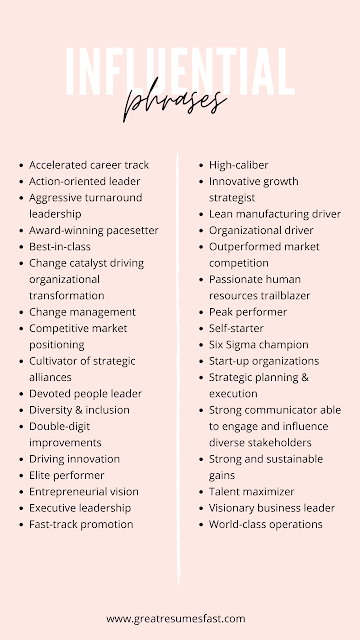
33 Stand-Out Phrases to Freshen Up Your Resume

by Jessica Holbrook Hernandez

How to Incorporate Noteworthy Phrases into Your Resume

I see the same phrases repeated on hundreds of resumes. (I’m looking at you “responsible for” and “duties included”!)

The problem with these worn-out words is that they carry no weight or power. 

They’re weak and vague.

One surefire way to pack more punch in your resume is to switch out the tired, overused phrases with strong action verbs that tell your story.

Strong action verbs are perfect to energize your resume bullets so they “WOW” employers.

Extra credit: they’re also great for leading into results-based statements.

An example of an accomplishment bullet using action verbs and stand-out phrases could sound like:

  • Turned around $750M budget deficit into a $300K surplus within 1 year by creating infrastructure, optimizing expenses, and cultivating strategic partnerships with 21 hospitals and medical device manufacturers. 

When we work with clients we use a C.A.R. formula to help us create memorable bullets. 

C – Challenge

A – Action

R – Result

I also often recommend this formula to my LinkedIn connections when they ask for resume writing advice:

(Action verb)(noun)(quantifiable metric or result)(action you took to achieve result)

An example of this formula filled out as a resume bullet would sound something like this:

  • Boosted revenue 64.5% by designing and implementing strategies to cut costs, improve efficiencies, and optimize production of 325 styles and 6.2M SKUs. 

Try the formula out in your resume as you work to write about your accomplishments.

33 Swipeable Phrases to Inspire You

I spoke with a senior-level job seeker last week who confided to me how hard it was to assess her own work. 

She hesitantly shared, “I struggle to convey my value.”

I get it. Boy, do I get it. 

Most of us struggle to explain our value. We know we’re talented and competent, but conveying that on a resume suddenly induces all kinds of writer’s block and analysis paralysis. 

If you want to reflect what you’ve accomplished and point out your value to employers, try using a few of these proven resume phrases:


The key is not to throw all of them into your resume. You want to use these sparingly so that they’ll have maximum impact. 

Read through the list and choose 2-3 that reflect you most accurately. 

Read the full Great Resumes Fast article for more tips on how to use the phrases and how to self evaluate to know which phrases to use  

6 Recruiter Tips To Getting Your Resume Seen And Landing An Interview

 Heidi Lynne Kurter

According to the career website, Ladders, recruiters spend only 7.4 seconds reviewing a resume. Meaning, you as a job seeker have less than 8 seconds to make an impression on them. Most job seekers want to share everything about themselves in their resume, therefore, their resume becomes cluttered and overwhelming for the recruiter. Moreover, the resume lacks a clear purpose making the recruiter confused about how a candidate’s skills will translate to the role in which they’re applying.

The career site discovered the resumes where recruiters spent the most time and focus had

  • an overview or mission statement at the top of the first page
  • a clear flow with title headers and marked sections supported by bulleted lists of accomplishments
  • relevant keywords presented in context throughout the resume

Here are six recruiter tips you can implement right away to get your resume seen and land a job.

1) Keep It Stupid Simple (K.I.S.S.)

Most of the time, the people hiring for the role have never worked in that position. For this reason, keep your resume simple and make sure it’s easily understood since they’ll be the ones reading it. To get noticed at a glance, Ben Lamarche, general manager of Lock Search Group, emphasized, “be sure to bullet point your most marketable skills and relevant management experiences. Don't go into so much detail that a reader can't form a quick mental picture of you as a candidate.”

Deepak Shukla, founder of Pearl Lemon, an SEO agency, said “cut out any fluff or experiences that are not relevant to the position. This puts greater emphasis on the information that actually matters to the recruiter.” Also, try to keep your resume to one page, but no more than two pages. David Reitman, Esq., owner of DLR Associates Recruiting, recommended to “focus on the past 5-10 years.” He said, “anything further in the past should simply be mentioned with no more than one line describing job duties.” Avoid repeating information. If your last job was similar to your current job, don't restate everything you did; instead say, “duties substantially similar to..”

2) Utilize The Words In The Job Description

Job seekers often complain about not getting their resume past the applicant tracking system (ATS). The reason being is because the ATS looks for specific keywords that are already in the job description. As a job seeker, it’s important to tailor your resume to include those keywords that are relevant to your experience.

Yaffa Grace, founder of The Essential Resume, advises her clients to take a yellow highlighter and highlight words that come up multiple times in the job description. She said, make sure you only use those keywords if you have the experience reflected in that keyword. You can do this by supporting those keywords with professional experiences that demonstrate you’re knowledgable. The worst thing you could do is lie about or exaggerate your experience. The interview will uncover those lies. If the interview doesn’t, your performance on the job surely will.

Lastly, if you’re going to claim you are detail oriented, make sure to review your resume for mistakes and have someone else look it over too. The quickest way to land in the rejected pile is by contradicting what you claim.

3) Tailor Your Resume To The Position

Most job seekers have multiple resumes. Each resume is tailored specifically for the role in which they’re applying by using the keywords in that job description. If you have a broad background and are applying for various types of positions, it’s important you tailor your resume to speak to the skills of those positions. For example, if you’re applying to a developer position, you would want to move non-relevant positions to “Additional Experience”, personalize your summary and skills section as well as the bullet points from your current and previous positions.

Chris Waltenbaugh, payment processing expert at Payment Depot, explained “for me, the resumes that stand out are the ones that show the person has taken time to think about the position in which they’re applying and carefully crafted a document that demonstrates their understanding and what’s unique about them that will bring value to the job.”

See all 6 tips and the complete Forbes article

6 Tips To Make Your Resume ATS Friendly

From resume screening tools to Robot Vera, an AI-based software technology that helps recruit and hire humans, it’s safe to say that the robots have become a necessary evil that job seekers need to contend with. Automation and machine learning have become a recruiter’s best friends, helping to sift through hundreds or thousands of applications. However, for an applicant the influx of tech can be overwhelming, conjuring up images of a robot apocalypse.

But before you panic or head for a nuclear bunker, there are a few things you can do to optimize your resume to get beyond the wall of bots and into the hands of a human recruiter. We spoke to Amanda Augustine, career advice expert for TopResume, a resume writing service that helps you craft a winning CV.

Here are her top tips for crafting a bot-beating resume:

1. Know Your Opponent

While it’s not likely that you’ll know who else is vying for an open position, recognizing what you’re up against is key. In the job application process, you are up against the ATS. “ATS stands for applicant tracking system. In short, an ATS is a piece of software used by employers to scan and rank the online job applications they receive for their open positions,” says Augustine. “These bots were initially created with large organizations in mind, which needed help sifting through the thousands of incoming applications they received on a weekly basis. An estimated 95% of Fortune 500 companies currently use an ATS to manage their applicant tracking process. Today, this software has become popular with employers and recruiting firms of all shapes and sizes.”

Think of ATSs as the gatekeepers to your dream job. You’ve got to get past them first in order to succeed.

2. Word Choice & Keywords Matter

Using action verbs like “outperformed,” “solved,” “led,” and “delivered,” are essential when crafting a resume. These compelling action verbs powerfully show off what you did in each of your roles. However, when it comes to the bots, you’ve got to kick things up a notch.

The most important element — beyond formatting your resume so it can be accurately ‘read’ and parsed by the ATS — is keyword optimization,” says Augustine. “This is how the applicant tracking system determines if you possess the necessary qualifications to be considered for the position. In addition to listing out a specific term, be sure to also include any common abbreviations to cover your bases.”

However, Augustine warns against keyword stuffing or packing your resume and cover letter with buzzwords. “If the ATS can’t sift through the B.S., I guarantee the recruiter or hiring manager will — and then promptly dismiss your application.” Instead use keywords sparingly and intelligently.

To make sure your resume is compatible with [any ATS] system, incorporate the best keywords throughout your resume 2-3 times, with at least one of those references falling within your Work Experience or Education section. It’s one thing to state that “SEO (search engine optimization)” is among your core competencies, but it’s another thing entirely to show where in your employment history you leveraged that knowledge to add value to an organization.”

3. Keep It Simple

While beautiful resume templates, custom cover letters, and charts may wow a human recruiter, chances are that the ATS bots won’t appreciate the extra effort. Here are Augustine’s fast few tips for keeping it simple:

  • Use a simple, clean design. Embedded charts and other images, custom font styles, and intricate bullet styles will get scrambled or simply skipped over when the ATS scans your application.
  • Avoid submitting your resume as a PDF unless the system specifically lists PDF files among the acceptable options. Some ATS software scans a PDF as though it were one big image, essentially missing all the information contained in your resume. Stick to a Word document that is compatible with all ATS systems.
  • Don’t include important details like your contact information in the header or footer. Again, not every ATS is able to read the information placed in these sections of a Word document.
  • Most importantly, customize your resume with keywords that represent the required soft and hard skills found in the job listings. Incorporate these terms throughout the resume, particularly in the “Key Skills” and “Work Experience” sections.

Read tips 4-6 and the complete article


Never put these 3 ‘outdated’ sections at the top of your resume, says career expert

 J.T. O’Donnell

Landing your dream job is all about making a good first impression, and much of that has to do with what you put at the very top of your resume. Unfortunately, too many job seekers don’t utilize this space to their best advantage.

One of the biggest mistakes job seekers make is starting their resumes with long-winded, boring and self-important paragraphs about how great they are. But guess what? Everyone applying for that position thinks they’re great and worthy of a recruiter’s time.

Here are three outdated resume techniques that no longer work with hiring managers:

  1. Summary statements: The responsibilities and accomplishments listed in the job history section of your resume should already paint a picture of what you bring to the table, so there’s no need to amplify it with a long preface.
  2. Objective statements: This doesn’t offer any new or useful information. What’s the point of spelling out the obvious fact that you’re interested in the position?

See all 3 things PLUS what to do instead


5 buzzwords that cost the candidate the job, according to recruiters

 Una Dabiero

While business buzzwords like “synergy” feel very official while you’re typing them out, using certain popular terms and phrases can actually hurt your chances of getting hired, according to Jason Walker and Ian Scott, two recruiters cited by Seek.

Here are the five words that make them toss an application, why they’re especially peevish and what to say instead.


3. “Workaholic”

Despite popular belief to the contrary, no one wants to hire a workaholic. These folks are the most likely to burn themselves out, lash out and complain. In fact, most recruiters would prefer you speak to the boundaries you set for yourself and how you accomplish great things despite these boundaries. Instead of citing being a workaholic as your weakness at work, Seek suggests citing “a nice to have skill you could develop such as public speaking or not delegating enough.”


5. “Motivated by change”

While flexibility is, of course, a coveted skill, saying you’re “motivated by change” requires a thorough story. Otherwise, the claim falls flat — and sounds anything but interesting. Why? Of course, you’re motivated by change! You’re trying to make a big change right now, according to Scott.

“In my experience, many people become active job-seekers because they have experienced change,” he said.

See all 5 buzzwords and the complete Ladders article


Your Résumé Can Beat the Bots – Here’s How 4 Top Tips


Ever wonder where your résumé goes after you apply to a job online? To organize the volume of applications, companies typically rely on applicant tracking systems to help keep them organized. Applicant tracking systems (ATS) are used to—often manually—scan résumés for keywords and skills that match the job description. While they are great programs to assist with ranking likely qualified candidates, they aren’t perfect, nor are the people that use them. Because there are countless ways to format a résumé, some could parse into the system cleanly while others are a jumbled mess. Not only does your résumé need to articulate your skills and experience, but its formatting also needs to be easy to read and review inside the ATS.

Not sure how to design your résumé to be searchable by applicant tracking systems? Don’t worry! These are our top tips for writing an ATS friendly résumé.

3) Make Your Résumé Easy to Read

The biggest improvement you can do to make your résumé easily readable is to format it thoughtfully. Hiring managers and recruiters need to be able to find the information they’re looking for quickly. You’ll need to catch their eye in the first few seconds, so make sure the content is well-organized!

• Use standard headers: The ATS won’t recognize “What I’ve learned” as your education or skills section, so it could put those qualifications under something else, potentially causing a hiring manager to miss them. Stick to Summary/Professional Summary, Skills/Skills Summary, Experience, Education, Certifications, etc. as a best practice.

• Use bullets to break up blocks of text: Huge blocks of text or work history that’s out of order make for difficult reading. Short bullets are easier to read and can accommodate more information on the page.

• Check your font: Use common fonts like Calibri or Arial at 10-12 pt. size. Any font with too many details may be illegible to the ATS… or difficult for the person reading your résumé and countless others. Avoid using more than two different fonts or colors. This could be distracting for the reader. After the 100th résumé that day, the recruiter will be thankful if you make things easier for them!

• Be clear about your education: If you have a degree, list it. If you only have coursework, be sure it’s clear that you haven’t finished the degree. Don’t misrepresent your education level on your résumé.

• In most cases, avoid graphics, charts, or images: Many ATS either can’t read them or completely jumble the content. So, even though it looks nice, avoid graphics on your résumé. Exceptions granted for creatives/designers in most instances here!

• Don’t put important information in the header or footer. Not all ATS can read the information in the header or footer sections of a document. Instead, list your contact information in a line under your name.

• Don’t overdo the keywords: It’s tempting to pad your résumé with as many keywords as you can think of but it may cause the ATS to rank you for jobs that don’t suit your skillset. Since you should be tailoring your résumé for each job, a quick search of the job description will have a list of keywords you can incorporate where applicable.

• Include all relevant information like portfolio or GitHub links. Providing access to examples of your work will tangibly highlight your skills. An interested hiring manager is likely to view these sites. Put your graphics, charts, and images there instead of on your résumé!

• Remove unnecessary sections: Résumés should be focused on the experience you have and how you used it. Personal interests like baking cinnamon buns and watching Netflix don’t need to be on your résumé.

• Remove professional references: If a manager wants your references, they’ll ask for them, so save the space on your résumé. Keep references on a separate sheet to easily send to any hiring managers who ask. You also don’t want anyone calling your references before you give them a heads up on the job you’re interviewing for and you advise them on what to highlight in your background.


4) Edit Your Résumé

• Follow common sentence structure and spelling guidelines. Not Every Word In A Sentence Should Be Capitalized. Spell check is also important. Adding keywords to your résumé is only helpful if you’ve spelled them correctly. Both Grammarly and ProWritingAid can help with sentence structure and spelling if that’s something you need.

• Not only does it need to be edited for spelling and grammar, but you should also edit for redundancy. Why say something in two sentences that can be said in one? When you think you are done editing your résumé, read it aloud (or have Google Docs read it to you). Your ears will hear problems that your eyes are skipping over.

• While you’re at it, check the length of your Skills Summary section. It’s great to list all the technologies and methodologies you’re skilled in, but showing how you used them within your Experience section will give an accurate picture of how you put them to use.

See all 4 Top Tips and the complete article